
Tax-Free Childcare is a UK government-topped childcare account. Parents pay money into a dedicated online account, the government adds a top-up to that money, and the combined funds are used to pay a childcare provider. It is a separate scheme with its own account, but it interacts with other support: Universal Credit and childcare vouchers affect whether and how you can use it, so check them before you apply.
What is Tax-Free Childcare?
The scheme exists to help parents meet the cost of childcare by pairing their own payments with a government top-up. Both are held in one online childcare account, which is the only place the money sits before it is paid out. The official guidance comes from GOV.UK (2026) and Best Start in Life (UK Government, DfE, 2026).
Permitted use of the account
The account pays for childcare from a registered provider. The provider must be signed up to Tax-Free Childcare before you can pay them from the account.
For disabled children, the account can also cover specialist equipment. The top-up limits for disabled children are covered in section 2, so this section only confirms that the scope of the account is wider when a child is disabled.
Managing the online account
The account is run through an online childcare account. You sign in there to see your details and confirm your eligibility.
How much does the government add?
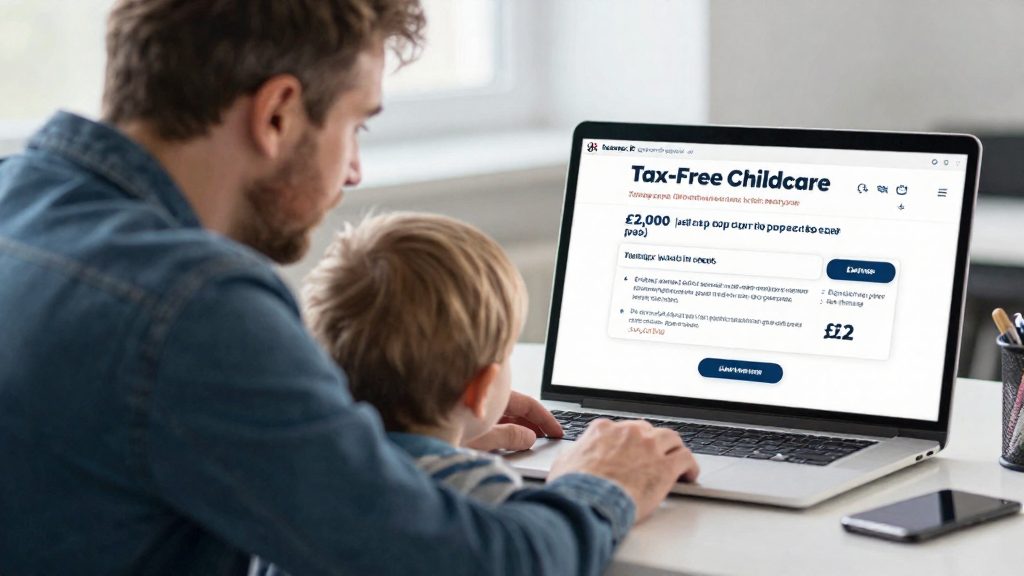
For every £8 you pay into a Tax-Free Childcare account, the government adds £2. That £2 covers 20% of the childcare bill, since each £10 of total childcare is £8 from you and £2 from the government. The top-up is capped per child, with a higher limit for a disabled child.
Top-up limits per child
| Child | Maximum top-up per quarter (3 months) | Maximum top-up per year |
|---|---|---|
| Standard child | Up to £500 | Up to £2,000 |
| Disabled child | Up to £1,000 | Up to £4,000 |
The caps apply to each child separately. The quarterly figure is the ceiling for each three-month period, so a yearly total is reached by adding up to four quarters.
How the 8:2 ratio works
The £2 for every £8 rule is a fixed ratio, so the top-up scales with what you pay until a cap is reached:
- Pay £80 in a quarter: the government adds £20, for £100 of childcare funded.
- Pay £2,000 in a quarter: the government adds £500, which is the standard quarterly maximum.
- For a disabled child, the disabled child limit of £1,000 per quarter is reached at £4,000 paid by you in that quarter.
Who can claim Tax-Free Childcare?
Eligibility depends mainly on the child’s age and the parent’s work status, and other conditions may apply, so check the full criteria on GOV.UK. GOV.UK (2026) sets the age limit at 11 or younger, or 16 or younger if the child is disabled. The rule applies to the child’s age, so check it against the child’s date of birth before you apply.
| Child | Maximum age |
|---|---|
| Not disabled | 11 or younger |
| Disabled | 16 or younger |
Work or return-to-work requirement
Parents usually need to be working or returning to work. The word “usually” in GOV.UK’s guidance means the rule has conditions. Read the full eligibility criteria on GOV.UK before assuming you qualify, particularly if you are between jobs, on leave, or returning after a break.
Disabled children
Best Start in Life (UK Government, DfE, 2026) also states that for disabled children the account money can cover specialist equipment, not only childcare fees. This is the main practical difference between the two categories.
How do I apply step by step?
The process runs in a fixed order: check you are eligible, check how Universal Credit or childcare vouchers affect you, open an online childcare account and confirm your details, find and add a provider that is signed up to the scheme, add money, pay that provider, then reconfirm your eligibility every 3 months.
Step 1: Open your online account and confirm your details
Start by opening an online childcare account on GOV.UK. Enter your personal details and those of your child, then confirm them when the account asks you to. Keep the details accurate, because the account is the place where your eligibility is recorded and where every later step is managed.
Step 2: Find your provider
Use the provider search in your account. You can search by the provider’s name, town or postcode. Select the correct entry and add it to your account so the payments can be directed to it.
Step 3: Notify a provider that is not listed
If you cannot find your provider, ask them to sign up to Tax-Free Childcare. Until they are, the search will not return them.
Step 4: Add money to your account
Sign in to your online childcare account and add money. The government adds £2 for every £8 you pay in, up to the cap for each child.
Step 5: Pay your provider
Once the money is in your account, pay your provider from it. The sequence is the same each time: add money, then pay the provider.
| Step | What you do | Where |
|---|---|---|
| 1 | Open account and confirm details | Online childcare account |
| 2 | Find provider by name, town or postcode | Provider search |
| 3 | Ask provider to sign up, if missing | Your provider |
| 4 | Add money | Online account |
| 5 | Pay the provider | Online account |
Can I claim with Universal Credit or vouchers?
Universal Credit and childcare vouchers both affect how Tax-Free Childcare works for your household. The GOV.UK guide makes checking them the second of its four steps, after the eligibility check and before you apply. Your answer depends on which support you already receive, so run this check first.
Universal Credit claimants
If you receive Universal Credit, check how your award would be affected before you apply. Have your current Universal Credit details to hand so you can compare your position before and after a Tax-Free Childcare top-up. Do not assume the result from another family’s experience, because the effect depends on your own circumstances.
Childcare vouchers
You cannot use Tax-Free Childcare and childcare vouchers at the same time. If you already receive vouchers through your employer, decide which scheme you will use before you open a Tax-Free Childcare account. Confirm with your employer how your current voucher arrangement stops or continues.
| Your situation | What to check first |
|---|---|
| Receiving Universal Credit | How your Universal Credit award is affected, then apply |
| Using childcare vouchers | Choose one scheme, because the two cannot be combined |
| Neither | Eligibility check, then apply |
How to pay your provider
Paying your provider is the last part of the Tax-Free Childcare process. The GOV.UK guide has four steps: check you are eligible, check how Universal Credit or childcare vouchers affect you, apply, then sign in to confirm your details and pay your provider.
Confirm your provider’s registration before you make your first payment.
Once you have signed in, use the account to pay your provider:
- Sign in to your online childcare account.
- Confirm that your details are correct.
- Pay your provider from the account.
- Check your online childcare account to confirm the payment has been made, or ask your provider to confirm they received it.
Payments usually appear within one working day, but this is not a guarantee. If your provider expects payment by a fixed date, such as before a term starts, make the payment a working day or more earlier than that date.
Why reconfirm every 3 months?
Tax-Free Childcare is not a one-time setup. You must reconfirm your eligibility every 3 months in your online childcare account, and this check continues for as long as you use the scheme. The initial application establishes that you qualify. Reconfirmation confirms that you still qualify at each three-month point, so completing the application does not cover later periods.
The reconfirmation checks the same conditions that apply at the start, and you usually need to be working or returning to work. If your circumstances have changed since your last confirmation, the reconfirmation is where the account records that change.
Missing a reconfirmation stops the scheme. GOV.UK states that if you do not reconfirm, Tax-Free Childcare stops. Do not assume it resumes automatically. Check GOV.UK guidance on what happens after a lapse before you rely on the next payment.
Because the check is recurring, treat it as a fixed task rather than a one-off. Note the three-month cycle when you open the account, and sign in to reconfirm before each cycle ends.
Common mistakes to avoid
Two habits can cause problems with this scheme: treating the government top-up as if it pays the whole childcare bill, and not checking the online account regularly. Both are easy to avoid once you know how the money flows.
Thinking the government pays the full childcare bill
The top-up is a fixed share of the cost, not the whole amount. The remaining 80% is yours to pay.
| Item | Amount |
|---|---|
| Paid by you into the account | £8 |
| Added by the government | £2 |
| Total childcare cost covered | £10 |
| Share of the bill covered by the top-up | 20% |
A budget built only around the top-up will fall short when the provider invoices the full amount. Calculate your monthly childcare cost first, then set aside the portion you must pay into the account.
Ignoring account messages and assuming money is still available
The online childcare account shows your status and your payments, so it is the first place to check when something looks wrong. If a payment you expected has not arrived by the time it should have, sign in and look at the account rather than waiting. Any message about your account status should be read and acted on promptly, not left in an inbox. The sources provided do not explain how unused money is handled, so check the balance shown in your account instead of assuming it will remain available.
Frequently asked questions
Can I use Tax-Free Childcare if I already receive childcare vouchers?
No. You cannot combine Tax-Free Childcare with childcare vouchers, so choose one before you apply. Check how Universal Credit affects your claim too, because it can change how the account works for you (GOV.UK, 2026).
What happens if I miss the quarterly check?
Your account stops receiving top-ups if you do not reconfirm eligibility every 3 months in your online childcare account. GOV.UK (2026) does not say whether the account restarts automatically, so check with GOV.UK before assuming payments will resume.
Which children qualify?
The child must be 11 or younger, or 16 or younger if disabled. You also usually need to be working or returning to work (GOV.UK, 2026).