The FSCS protects up to £120,000 of eligible deposits per person, per authorised firm, for firms that fail from 1 December 2025. For most savers, this means that total deposits held at one firm, across all its accounts, are fully covered up to £120,000. Any amount above that figure falls outside the deposit limit.
How much of your savings does the FSCS protect?
The £120,000 per eligible person limit is one combined figure for each firm, not a separate limit per account. Balances are added together across current accounts, savings accounts, cash ISAs and savings bonds held with the same firm.
Brands owned by the same authorised firm share that single limit. Balances held under different brand names at that firm are added together and compared with £120,000, not with each brand separately.
The examples below show how the limit applies to total balances held at one firm:
| Total held at one firm | Protected by FSCS | Not covered by the deposit limit |
|---|---|---|
| £20,000 in one savings account | £20,000 | £0 |
| £120,000 across a current account and a cash ISA | £120,000 | £0 |
| £150,000 across two brands of the same firm | £120,000 | £30,000 |
For a typical saver with balances under £120,000 at one firm, the whole amount is protected and no account needs its own cap.
What changed on 1 December 2025?
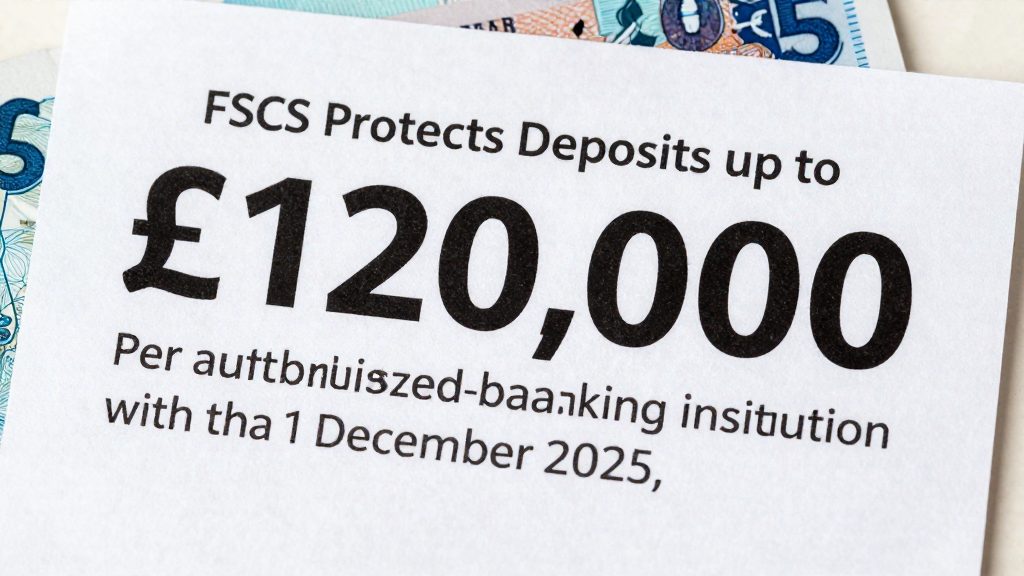
The FSCS deposit protection limit rose from £85,000 to £120,000 per eligible person, per authorised firm, effective from 1 December 2025. The £85,000 limit had applied since 1 January 2017. The Prudential Regulation Authority (PRA), part of the Bank of England, described the increase as an update that adjusts the 2017 figure for inflation.
The new figure was not the first one proposed. The PRA initially proposed £110,000, then revised the figure after consultation to £120,000. It confirmed the increase on 18 November 2025, about two weeks before the new limit took effect.
| Date or period | Limit per eligible person, per authorised firm | Status |
|---|---|---|
| 1 January 2017 to 30 November 2025 | £85,000 | Previous limit, set in 2017 |
| Earlier PRA proposal | £110,000 | Revised after consultation |
| 18 November 2025 | £120,000 | Increase confirmed by the PRA |
| From 1 December 2025 | £120,000 | Current limit |
The change affects the single number you check against your balances, but it does not change how the limit is measured. Confirm that your bank or building society is PRA-authorised, then compare your total balance with it, not with the old £85,000 figure. The limit applies to the total you hold across the firm.
Are joint accounts covered twice?
Yes, in the sense that each holder is protected separately, up to £120,000 each. The FSCS deposit protection limit is £120,000 per eligible person, per authorised firm, and it applies from 1 December 2025. Protection attaches to each person rather than to the account, so every joint holder is covered up to £120,000. A two-holder joint account is therefore protected up to £240,000 with one authorised firm. The account does not have a single shared ceiling.
How the per-person limit applies
The limit is counted per joint holder, not per account. Each holder’s position counts toward that holder’s own £120,000 limit. How a joint balance is divided between holders for this calculation is not set out here, so confirm the split with the firm or the FSCS before relying on a specific figure.
| Account situation (same authorised firm) | Maximum protection |
|---|---|
| Single-holder account, failure from 1 Dec 2025 | £120,000 |
| Two-holder joint account, failure from 1 Dec 2025 | £240,000 |
| Two-holder joint account, failure before 1 Dec 2025 | Earlier £85,000 per-person limit applies |
Personal accounts at the same firm
A holder’s individual accounts at the same authorised firm also count toward that holder’s £120,000 limit. A joint account adds protection for each holder only up to the per-person figure. It does not create extra room for money a holder already keeps in their own name at that firm. Balances above the applicable limit for each holder are not covered by the FSCS deposit limit.
Do different brands share one limit?
Yes. The £120,000 limit is set per eligible person, per authorised firm, not per brand name. If one firm runs several savings brands, every balance held with those brands is added together and measured against one limit. The FSCS and the Bank of England both state that accounts under different brands owned by the same firm share that single £120,000 limit.
The same rule applies to banks in the same group that share one banking licence. They count as one bank, so the £120,000 applies to your total across all of them, not to each account. Checking the brand name on a statement is not enough. You need to confirm which authorised firm holds the licence behind each account.
To check your exposure:
- Identify the authorised firm behind each account, using the firm name in the account terms or the FSCS and Bank of England listings.
- Group together every balance held with brands that belong to the same firm.
- Compare the total with £120,000.
The table below shows how the limit works for one person with two accounts at brands owned by the same firm. These figures apply to a firm failing from 1 December 2025.
| Combined balance with the firm | Amount protected | Amount above the limit |
|---|---|---|
| £100,000 | £100,000 | £0 |
| £120,000 | £120,000 | £0 |
| £150,000 | £120,000 | £30,000 |
Which accounts and products are covered?
FSCS deposit protection covers money held in current accounts, savings accounts, cash ISAs and savings bonds. Two conditions must both be met: the product must be one of these types, and the institution must be a PRA-authorised UK bank, building society or credit union. A balance that fails either test falls outside the deposit protection scheme, regardless of how the account is marketed.
Covered deposit types:
- Current accounts
- Savings accounts
- Cash ISAs
- Savings bonds
Covered institutions:
- PRA-authorised UK banks
- Building societies
- Credit unions
Before opening or moving money, confirm that the institution holds PRA authorisation. The institution must be PRA-authorised for its deposits to be in scope. Check the status for each institution separately, since a single brand name does not guarantee authorisation for every entity behind it.

What are temporary high balances?
A temporary high balance is a large sum held in a UK deposit account that temporarily exceeds the standard protection level after a specific life event. The Prudential Regulation Authority (PRA), part of the Bank of England, confirmed on 18 November 2025 that protection for temporary high balances rises from £1 million to £1.4 million. The higher level of £1.4 million applies for up to six months after a qualifying life event, such as selling a home or receiving an inheritance.
Protection levels and timing
| Item | Figure | Source |
|---|---|---|
| Temporary high balance protection before the change | £1 million | PRA, 18 November 2025 |
| Temporary high balance protection after the change | £1.4 million | PRA, 18 November 2025 |
| Duration of the higher protection | Up to six months after the life event | PRA, 18 November 2025 |
Qualifying life events
The higher limit is tied to a qualifying life event, not to the size of the balance alone. Two examples:
- Selling a home
- Receiving an inheritance
The list is introduced as “such as”, so it is not presented as complete. For any other event, check the current FSCS guidance before relying on the higher limit.
Using the six-month window
The six-month window starts from the life event. The higher temporary protection, up to £1.4 million, applies only for up to six months after a qualifying life event. Check the current FSCS guidance on temporary high balances.
What if your bank fails before the new limit applies?
The £120,000 limit applies only to firms that fail from 1 December 2025. If your bank failed before that date, the £85,000 limit still governs your eligible deposits with that firm. The deciding factor is the failure date of the firm, which determines the limit that applies.
| Date the firm fails | Deposit protection limit per eligible person, per authorised firm |
|---|---|
| Before 1 December 2025 | £85,000 |
| From 1 December 2025 | £120,000 |
The increase from £85,000 to £120,000 was confirmed by the PRA on 18 November 2025, with effect from 1 December 2025. It updates the original figure for inflation but does not extend to firms that failed earlier. Those firms remain subject to the £85,000 limit.
How to check your protection
Checking your protection means totalling what you hold at each authorised firm and comparing that total with the £120,000 limit, which applies per eligible person from 1 December 2025. The method has four steps: list every deposit, count the holders on each account, group the banks that share a licence, and compare the totals.
Step 1: List every deposit by firm and brand
Record each account under the firm that holds the banking licence, not only the name shown in the app or on the statement. Covered deposits include current accounts, savings accounts, cash ISAs and savings bonds.
| Record | Where to find it | Purpose |
|---|---|---|
| Firm name | Account terms or statement | Identifies the authorised firm |
| Brand name | App, card or statement header | Shows accounts that sit under one firm |
| Product type | Account opening documents | Confirms the account is a covered type |
| Balance | Latest statement | Gives the figure to compare with the limit |
Step 2: Count the holders on each account
Note the number of holders for every joint account, because this changes the protection available to each person.
Step 3: Group banks that share one licence
Banks in the same group that share a banking licence count as one bank, so combine their balances. To find out which licence an account uses, check the firm’s terms or ask the firm directly.
Step 4: Compare each total with the limit
For each person and each authorised firm, add the covered deposits from Steps 1 to 3 and compare the result with £120,000 (or £240,000 for a two-holder joint account). Any amount above the limit at that firm is not protected by the scheme.
Frequently asked questions
What happens to savings above £120,000 at one firm?
Amounts above the £120,000 limit at one firm fall outside the deposit limit, but a temporary high balance can be protected up to £1.4 million for up to six months after a qualifying life event, such as selling a home or receiving an inheritance. After that window, the standard limit applies, and the FSCS guidance explains how the remaining balance is treated.
Does a joint account get protection for each holder?
Each eligible person is protected separately, so a two-holder joint account can be protected up to £240,000 for firms that fail from 1 December 2025. This is a maximum, because each holder’s share is reduced by any other deposits they hold at the same firm. For firms that failed before that date, the earlier £85,000 per-person limit applies.
Do pensions and investments count toward the £120,000 deposit limit?
No. Pensions, investments, insurance, mortgages and funeral plans sit outside the £120,000 deposit limit and have their own FSCS protection limits. Only deposits held with a PRA-authorised institution count, including building societies and credit unions.