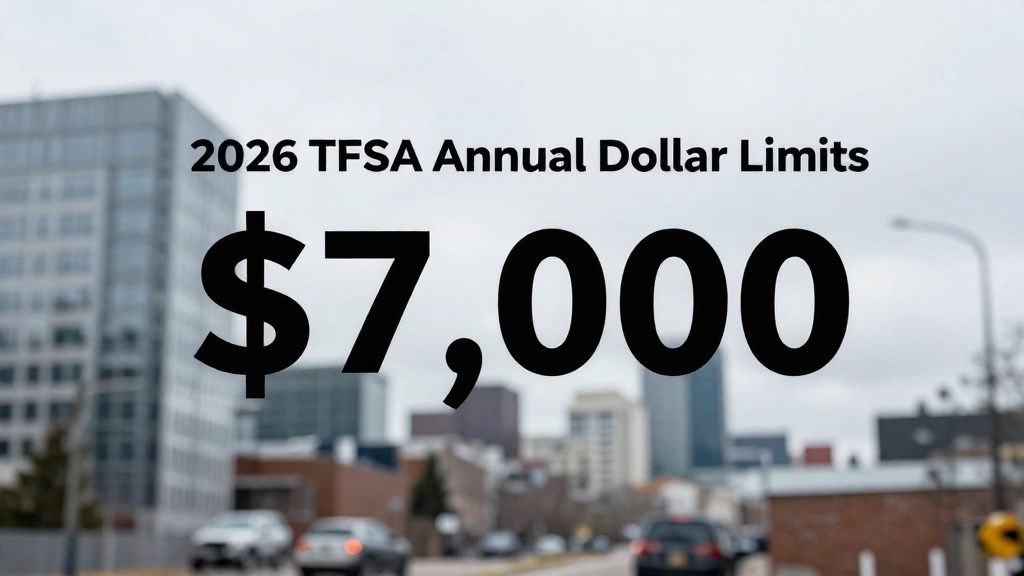
The TFSA annual dollar limit for 2026 is CAD 7,000, the same as in 2024 and 2025. Someone eligible since 2009 who has never contributed has cumulative room of CAD 109,000 in 2026, up from CAD 102,000 in 2025. Source: Investment Executive, 2025-10-01.
What is the TFSA limit for 2026?
How the annual limit is set
The annual dollar limit starts from a base of CAD 5,000, is indexed to inflation after 2009, and is rounded to the nearest CAD 500. The 2026 figure stays at CAD 7,000, matching 2024 and 2025.
Cumulative room by year
| Tax year | Annual dollar limit | Cumulative room (eligible since 2009, never contributed) |
|---|---|---|
| 2025 | CAD 7,000 | CAD 102,000 |
| 2026 | CAD 7,000 | CAD 109,000 |
Source: Investment Executive, 2025-10-01.
When room starts and how it returns
Room starts accumulating in the year you turn 18, if you are a Canadian resident with a Social Insurance Number (SIN). To open an account and contribute, you must also have reached the age of majority in your province or territory.
Amounts withdrawn are added back to contribution room in January of the following calendar year. Room lost to investment losses before a withdrawal is gone permanently. Source: Fidelity Investments Canada, 2026-01-30.
What happens to excess contributions
Contributions above your room are excess contributions. They are taxed at 1% per month on the highest excess amount until withdrawn. Source: Fidelity Investments Canada, 2026-01-30.
Checking your room before contributing
The Canada Revenue Agency (CRA) said that TFSA records from 2025 would be processed by April 2026. It recommends checking your room in your CRA account and comparing it with your financial institution’s records to avoid over-contributing. Source: Canada Revenue Agency, 2026-01-06.
How TFSA contribution room is calculated
Your cumulative room is the total amount you are allowed to contribute, and it builds up from the year you turn 18 if you are a Canadian resident with a SIN. The calculation depends on three inputs: the annual limit, the number of eligible years, and adjustments from withdrawals and excess contributions. The annual limit started from a CAD 5,000 base, is indexed to inflation after 2009, and is rounded to the nearest CAD 500. For 2026 it is CAD 7,000, the same as in 2024 and 2025.
The method, step by step:
- Confirm eligibility years. Room starts accumulating in the year you turn 18. Opening an account and contributing also requires the age of majority in your province or territory.
- Add the annual limit for each eligible year. As an example, someone eligible since 2009 who has never contributed has $109,000 of cumulative room in 2026, up from $102,000 in 2025.
- Add back withdrawals. Amounts withdrawn are added to room in January of the following calendar year.
- Subtract contributions already made. The result is the room available for new contributions.
| Element | Rule | Source (date) |
|---|---|---|
| Base limit | $5,000, starting point of the limit | Investment Executive (2025-10-01) |
| Indexation | Follows inflation after 2009, rounded to the nearest $500 | Investment Executive (2025-10-01) |
| 2026 annual limit | $7,000 | Investment Executive (2025-10-01) |
| Withdrawals | Added back to room in January of the following year | Fidelity Investments Canada (2026-01-30) |
| Losses before a withdrawal | Room lost to investment losses is gone permanently | Fidelity Investments Canada (2026-01-30) |
Checking the figure matters because the CRA says TFSA records from 2025 will be processed by April 2026. Compare the room shown in your CRA account with your financial institution’s records to avoid over-contributing.
Cumulative room since 2009: up to $109,000
Cumulative room is the total contribution room a person builds up over time, not the annual limit. Someone eligible since 2009 who has never contributed has $109,000 of cumulative room in 2026, up from $102,000 in 2025. The figure is personal: it depends on the eligibility date and on any past contributions or withdrawals.
| Situation | Effect on room |
|---|---|
| Never contributed, eligible since 2009 | $109,000 cumulative room in 2026 (up from $102,000 in 2025) |
| Amount withdrawn | Added back in January of the following calendar year |
| Room lost to investment losses before a withdrawal | Gone permanently |
| Contribution above available room | Taxed at 1% per month on the highest excess amount until withdrawn |
Room starts accumulating in the year you turn 18, provided you are a Canadian resident with a Social Insurance Number. Opening an account and contributing also requires reaching the age of majority in your province or territory. A person who turned 18 later will therefore have less cumulative room than the $109,000 figure, even with the same contribution history.
To confirm your own balance, the Canada Revenue Agency (CRA) recommends checking your room in your CRA account and comparing it with your financial institution’s records. The CRA states that TFSA records from 2025 will be processed by April 2026, so figures shown online may not reflect the most recent year until that processing is complete.
Withdrawals: when does the room come back?
Money taken out of a TFSA does not return to your contribution room in the same year. Withdrawn amounts are added back in January of the following calendar year. A withdrawal made at any point in 2026 restores room in January 2027, and a withdrawal made in 2027 restores room in January 2028.
| Withdrawal made in | Room restored in |
|---|---|
| 2026 | January 2027 |
| 2027 | January 2028 |
The restoration applies only to the amount withdrawn. If the account lost value before the withdrawal, the room tied to that loss is different: any room lost to investment losses before the withdrawal is gone permanently and is not restored.
Contributing more than your available room creates an over-contribution. Excess contributions are taxed at 1% per month on the highest excess amount until that excess is withdrawn.
To confirm your available room before contributing after a withdrawal, check your room in your CRA account and compare it with your financial institution’s records. The CRA states that TFSA records from 2025 will be processed by April 2026, so older figures may not match until then.
Where to check your contribution room in CRA My Account
The Canada Revenue Agency (CRA) recommends checking your contribution room in your CRA My Account and comparing it with your financial institution’s records. This two-source check is the CRA’s stated way to avoid over-contributing. The 2026 annual dollar limit is $7,000, the same as in 2024 and 2025, so your room figure should reflect that limit plus any unused room carried from earlier years.
Follow these steps:
- Sign in to your CRA My Account and open the TFSA section to view your room.
- Note the cumulative room shown. Room accrues from the year you turned 18; the age of majority in your province or territory only affects when you can open an account and contribute.
- Log in to each TFSA provider and find the contributions and withdrawals recorded for the year.
- Compare the two sets of figures. If they differ, identify which contributions or withdrawals are missing from one source before you contribute again.
The CRA said TFSA records for 2025 would be processed by April 2026, so the account figures should reflect that processing. A withdrawal does not restore room immediately. The withdrawn amount is added back to your room in January of the following calendar year, so an amount you withdrew in 2026 becomes available again in January 2027.
What happens if you over-contribute?
Contributing more than your TFSA room is penalized directly. Excess contributions are taxed at 1% per month on the highest excess amount until that excess is withdrawn. In plain terms, the cost is 1% × highest excess amount × number of months the excess stays in the account. The penalty therefore grows with time, so the sooner the excess is removed, the smaller the cost.
| Element | Rule |
|---|---|
| Penalty rate | 1% per month |
| Base | Highest excess amount |
| Penalty stops | When the excess is withdrawn |
| Room restored | Amount withdrawn is added back in January of the following calendar year |
Withdrawing the excess stops the 1% monthly tax from continuing to apply to that amount. Before contributing again, check your available room in your CRA account and compare it with your financial institution’s records.
To reduce the risk, the CRA recommends checking your room in your CRA account and comparing it with your financial institution’s records. The CRA states that TFSA records from 2025 will be processed by April 2026, so balances shown in your account may change during that processing period.
At what age do you start accumulating room?
In Canada, TFSA contribution room begins to build in the year you turn 18, provided you are a Canadian resident with a Social Insurance Number (SIN). Room accumulates from that year onward, so a person who turns 18 in 2026 starts accruing room that year, regardless of when in the year the birthday falls. Contributing, however, is a separate condition. To open an account and make deposits, you must also have reached the age of majority in your province or territory, which can be later than 18 in some jurisdictions.
| Milestone | Requirement |
|---|---|
| Room starts accumulating | Year you turn 18 |
| Residency and identity | Canadian resident with a SIN |
| Opening an account and contributing | Age of majority in your province or territory |
The distinction matters for budgeting. Room may be building while you are not yet able to open an account, so the unused room is still available once you meet the age of majority. Room is not lost by waiting. Each year after you turn 18 adds to your cumulative total, and unused room carries forward.
Frequently asked questions
Does unused TFSA room carry over to the next year?
Yes. Your cumulative room builds up each year you are eligible, so room you did not use in earlier years remains available. The CAD 7,000 annual dollar limit is the yearly cap that applies on top of that total.
If I withdraw money, when can I contribute that amount again?
Withdrawn amounts are not restored in the same year. They return to your contribution room on 1 January of the following calendar year, so plan any re-contribution for that new year.
What if I contribute more than my room allows?
Excess amounts are subject to a 1% monthly tax on the highest excess balance until you withdraw it. The sources reviewed do not confirm that withdrawing an excess contribution restores your room, so do not assume it will.