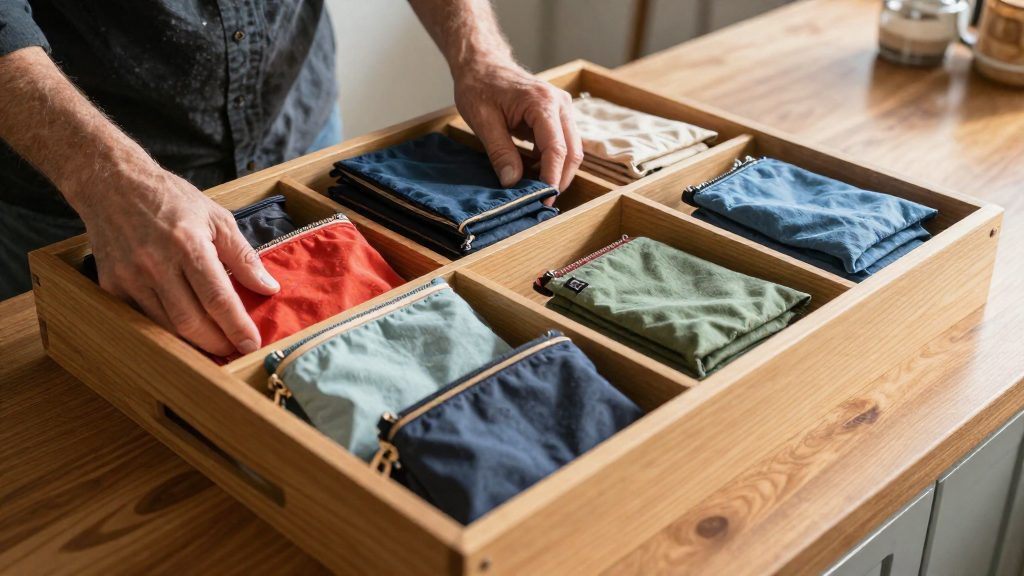
Two incomes do not automatically make a household budget. When each partner pays bills from a separate account and nobody records the full picture, shared costs and spending gaps stay hidden. Credit Canada advises that when several people share a budget, they communicate openly and agree on shared goals. A single shared plan gives both partners the same view of income, spending and savings.
Why does a two-income household need a shared budget?
Open communication about money
Start by sharing the facts. Each partner should disclose their take-home pay, existing debts and regular obligations, so both work from the same numbers instead of assumptions. Repeat this conversation whenever pay changes or a large unplanned cost appears, so that visibility stays current rather than being a one-time exercise.
Agreeing on shared goals together
Credit Canada recommends agreeing on shared goals as a couple. Write down the targets both partners accept, such as a common savings amount, a planned purchase or a debt repayment date. Goals agreed by only one partner can create friction later, so a plan works best when both names are on it. Shared goals also give spending decisions a common reference point, which makes trade-offs easier to discuss.
Risks of separate, untracked accounts
When each partner runs a separate account and no one records the shared spending, the budget covers only part of the household. A bill paid from one account, a subscription charged to another and an irregular purchase can each go unseen by the other partner. This is how untracked accounts produce spending gaps that surface only at month-end. Registered savings are affected too: a contribution room that one partner does not monitor can lead to accidental over-contribution.

Start with combined after-tax income
Credit Canada builds a household budget on after-tax household income, the money that actually reaches your accounts after taxes and deductions. For a two-income household, the starting figure is the sum of both partners’ take-home amounts plus every other source of money the household receives each month.
| Income source | Include in the total? | How to count it |
|---|---|---|
| Wages (each partner) | Yes | Net pay after tax and deductions, not gross salary |
| Government benefits, including the Canada Child Benefit | Yes | Convert to a monthly amount |
| Support payments | Yes | Use the amount actually received |
| Side income | Yes | Count only the after-tax portion |
| Variable income (commissions, shifts, freelance work) | Yes, at a lower level | Use your lowest recent monthly earnings |
To build the figure:
- Write down each partner’s net monthly pay from their pay statements.
- Add government benefits and support payments, converted to a monthly amount if they are paid less often than monthly.
- Add any side income after deducting tax on it.
- For variable income, take the lowest monthly total from your recent months. Credit Canada’s guidance refers to recent earnings without specifying a fixed period, so choose a window that reflects your actual pattern.
- Add the results. This total is the figure your budget is built on.
When one partner’s income is steady and the other’s varies, combine the steady amount with the variable baseline. Any month that exceeds the baseline is extra money, not part of the planned budget.
Track fixed, variable and irregular expenses
Every outgoing cost falls into one of three groups. Sorting them first makes the rest of the budget easier to manage, because each group behaves differently and needs a different way of tracking.
Fixed expenses stay the same amount each period because a contract or agreement sets them. Common examples include rent or a mortgage payment, a phone plan and an insurance premium. They are the easiest to forecast, so they form the base of the budget.
Variable expenses change from month to month because they depend on your choices and usage. Groceries, personal spending and eating out are typical examples. Credit Canada recommends separating these from fixed costs, so you can see which part of the spending you can actually adjust.
Irregular expenses come up at uneven intervals or once a year, so they rarely show up in a single month’s statements. Typical examples are annual subscriptions, school costs, gifts and one-off repairs.
| Group | Behaviour | Typical examples | How to track it |
|---|---|---|---|
| Fixed | Same amount each period | Rent or mortgage, phone plan, insurance premium | Confirm the amount against each statement |
| Variable | Changes each month | Groceries, personal spending | Record every transaction in the period |
| Irregular | Occurs at uneven intervals | Annual subscriptions, gifts, school costs | Note the yearly total for each item |
Track spending for three to six months
Credit Canada recommends tracking spending over a period of three to six months. The routine is simple: download transactions from each bank account and credit card, assign every line to a category from the table, then total each category by month. Compare the totals with your after-tax household income.
Build a sinking fund for irregular costs
Credit Canada advises setting aside small monthly amounts for irregular costs in a sinking fund. Apply the calculation to each irregular item in the table above, such as annual subscriptions or school costs. Add up the yearly cost of each item, divide the total by 12, and transfer that amount to a separate savings account every month. When the bill arrives, the money is already there, and it does not have to come from your day-to-day spending.
How should couples split shared costs?
Shared costs are usually divided in one of three ways: proportional (each partner pays a share matching their share of total income), equal (each pays half), or custom (partners assign specific bills to specific people). No official source sets a recommended ratio, so the right formula depends on the couple’s situation.
| Formula | How it works | Typically fits when |
|---|---|---|
| Proportional | Each partner pays the same percentage of each shared bill, based on their share of after-tax income | Incomes differ noticeably |
| Equal | Each partner pays half of each shared bill | Incomes are similar |
| Custom | Each partner pays specific bills or categories, such as rent or groceries | Partners want clear ownership of particular costs |
Whichever formula is chosen, write it down as a rule so it does not need to be renegotiated each month.
Handling unequal incomes
When one partner earns much more than the other, an equal split can leave the lower earner with little room after shared bills. A proportional split keeps the contributions in step with income.
Personal spending allowances outside shared accounts
A personal allowance is a fixed amount each partner can spend freely, with no need to justify it to the other. Set it after shared bills are funded, and treat it as its own line in the budget so it is planned rather than left over. Equal allowances are the simplest to agree on. If incomes differ, the allowances can stay equal while the shared contributions follow the chosen formula, which keeps personal spending parallel even when earnings are not.
Match bills to pay dates and benefit dates
Two-income households can match outflows to inflows by placing three sources of money on one calendar: each paycheque, the Canada Child Benefit (CCB), and the GST/HST credit, which the CRA now lists as the Canada Groceries and Essentials Benefit. The CRA publishes 2026 payment dates for each, so you can map them once and check them against your bill due dates.
Canada Child Benefit, 2026 payment dates (CRA):
| Month | Payment date |
|---|---|
| January | January 20 |
| February | February 20 |
| March | March 20 |
| April | April 20 |
| May | May 20 |
| June | June 19 |
| July | July 20 |
| August | August 20 |
| September | September 18 |
| October | October 20 |
| November | November 20 |
| December | December 11 |
GST/HST credit and Canada Groceries and Essentials Benefit (CRA):
| Benefit | 2026 payment dates |
|---|---|
| GST/HST credit | January 5, April 2 |
| Canada Groceries and Essentials Benefit, formerly the GST/HST credit | July 3, October 5 |
Finding cash-flow gaps is a three-step check:
- Write each bill’s due date next to the paycheque that arrives before it.
- Mark every day when a bill is due before the next paycheque lands. These are your cash-flow gaps.
- Check whether a benefit payment date falls inside each gap. If one does, the benefit can cover the bill without a shortfall.
Using the 2026 calendar, the only benefit dates left after October 29 are the CCB payments on November 20 and December 11. Any gap in late 2026 that is not covered by those dates has to be bridged from your paycheques.
Which budgeting method suits your household?
Credit Canada, a non-profit credit counselling organization, lists four budgeting methods: sustainable spending, 50/30/20, zero-based, and envelope or category budgeting. They differ in how tightly they control spending and how much detail you need to maintain. Choose the method that matches how much control you want.
Comparing the four methods
| Method | How it works | Best fit for |
|---|---|---|
| Sustainable spending | Sets spending limits that the household can keep up over time, instead of strict cuts | Households that want flexibility and a plan they can maintain |
| 50/30/20 | Splits after-tax income into needs, wants and savings | Households that want a simple top-level split |
| Zero-based | Assigns every dollar of after-tax income to a category until none is left unassigned | Households that want full control and will update the plan regularly |
| Envelope or category | Allocates a fixed amount to each spending category and stops spending in that category once it is used up | Households that overspend in specific categories, such as dining out |
Matching a method to your household style
Choose the method by looking at how your money is actually handled:
- If one partner handles most bills and wants detailed control, zero-based budgeting gives the clearest picture of each dollar.
- If spending is mostly steady and the goal is to avoid rigid rules, sustainable spending or 50/30/20 is easier to keep.
- If one category regularly exceeds its target, envelope or category budgeting limits that category directly without changing the rest of the plan.
Choosing a method you both accept
Use these steps before settling on a method:
- Each partner names their top two or three priorities, such as saving for a specific purchase or reducing debt.
- Test the chosen method against current spending to check that it covers all the categories you both care about.
- Agree in advance on what happens when one partner’s spending goes over a category limit, so the method does not become a source of conflict.
Where does tax-free savings fit in?
A Tax-Free Savings Account (TFSA) belongs in the savings layer of a two-income budget, after fixed and variable costs are covered. Its main budgeting risk is contributing more than your available room. The Canada Revenue Agency (CRA) advises checking your contribution room against your financial institution’s records to avoid over-contributing. The CRA TFSA page states that TFSA records from 2025 were to be processed by April 2026. As of October 2026, that date is already past.
Verifying contribution room
Reconcile two sources before you record a contribution as safe:
| Step | Source | What to confirm |
|---|---|---|
| 1 | CRA TFSA room figure | The room currently recorded for each person |
| 2 | Each financial institution | Contributions and withdrawals recorded for every TFSA held |
| 3 | Your budget file | Total contributions made this year, listed per person |
| 4 | Both sources compared | Any gap between the CRA figure and the institution totals |
Track each person separately. Room is individual, so a joint budget line that combines two people’s totals hides the figure that matters.
Reconciling mismatches
If the CRA figure and an institution’s records disagree, do not assume either one is right. Confirm the contributions and any withdrawals that the institution recorded, then check whether the difference comes from a recent transaction not yet reflected on one side. If a 2025 figure still differs after the April 2026 processing date stated by the CRA, the mismatch needs follow-up before you contribute more.
Over-contribution risks
Contributing above your room can have tax consequences. Check the CRA TFSA page for the details. This guide does not state penalty rates or correction procedures, because the verified source set for this section does not include them. Check the CRA TFSA page for the consequences and the correction process before you act on an excess amount.
Review and adjust the budget
A household budget with two incomes needs a fixed review schedule and clear triggers for changes. Without them, the plan drifts away from actual income and spending. Once the initial tracking period is complete, a fixed review schedule keeps the numbers current.
Choose a cadence that matches how often your costs change:
| Review type | Main purpose | What to check |
|---|---|---|
| Monthly check-in | Catch overspending early | Actual spending against each variable category |
| Quarterly review | Update variable limits | Sinking fund balances and irregular costs that came due |
| Annual review | Reset long-term targets | Savings goals, sinking fund amounts, and TFSA contribution room |
Some events should trigger an immediate adjustment, without waiting for the next scheduled review:
- Income change: a new job, a reduced work schedule, or a change in side income. Recalculate the after-tax total before adjusting any spending category.
- Expense change: a new fixed cost, such as a lease renewal or a new childcare arrangement, or a recurring cost that has increased.
- Benefit timing: the GST/HST credit and the Canada Groceries and Essentials Benefit are paid only on the dates listed in the payment-dates section above, so plan around those dates and decide together how to use each payment. The CCB is paid monthly and stays in the monthly household income, so a regular CCB payment does not trigger an adjustment on its own.
For a sinking fund, recalculate the monthly contribution when an irregular cost changes. Divide the expected amount by the number of months until it is due. Revise the figure whenever the expected cost or due date changes.
Because two people share the budget, adjustments should be agreed on jointly.