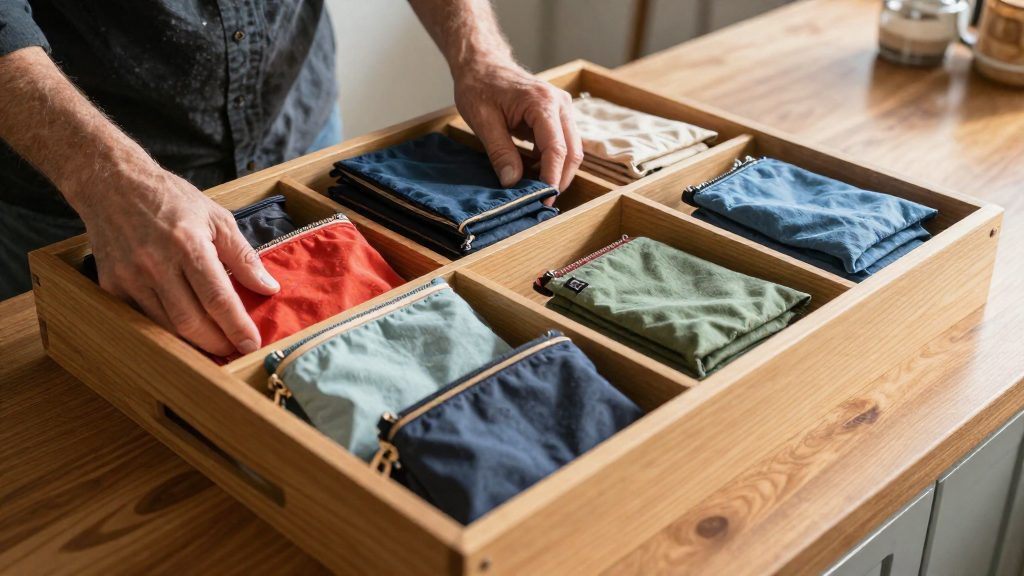
Irregular expenses are costs that do not come up every month. Credit Canada sorts them into three groups: seasonal costs, emergency costs, and one-time costs. Because each cost arrives at an uneven interval, it can break a monthly budget unless the money is set aside in advance. Envelope budgeting handles this by dividing each expected cost into regular monthly amounts that accumulate until the bill is due.
What Is an Irregular Expense?
An irregular expense is a cost that is not part of the recurring monthly outlay, such as rent or a fixed subscription. It may occur once a year, once every few years, or without warning. Credit Canada’s classification, dated 2024-09-12, identifies three categories:
| Category | Examples given by Credit Canada |
|---|---|
| Seasonal | Holiday gifts, summer trips |
| Emergency | Car repairs, medical bills |
| One-time | Appliance purchases, major renovations |
The categories help show which costs have a known date and which do not. A seasonal cost, such as holiday gifts, falls on a known date, so its timing can be planned. Emergency costs have no fixed date, so the envelope must be funded before the need arises. One-time costs are large single purchases that are usually not repeated.
Credit Canada’s example shows the mechanism. A $600 car insurance bill due in six months requires $100 per month in a dedicated envelope. The expense is irregular because it appears once in the budget period, not because it is small or unexpected.
Envelope budgeting, as described by Spergel (dated 2025-04-24), is a cash-based method in which each category receives a set amount in a labelled envelope. Fixed expenses such as rent usually do not need envelopes. Irregular expenses are the main candidates for them, because they are the costs most likely to be missing from a monthly plan.

How the envelope method works
Envelope budgeting is a cash-based method: each spending category gets a fixed amount of cash in a labelled envelope. When an envelope is empty, spending in that category stops unless you consciously move money from another envelope. Fixed expenses such as rent usually don’t need an envelope. For irregular expenses, the envelope fills gradually before the bill is due, so the cost doesn’t land in a single month.
Sizing the monthly amount
Credit Canada suggests estimating the yearly total of irregular costs and dividing it by 12, or setting aside 1–2% of monthly income as an alternative. For a single known bill, as in its car insurance example, divide the amount by the number of months left before the due date.
| Situation | Total to cover | Months before due date | Monthly deposit |
|---|---|---|---|
| Car insurance bill | $600 | 6 | $100 |
| Yearly irregular costs | $1,200 | 12 | $100 |
Both examples come from Credit Canada (2024-09-12).
Building the list of envelopes
Credit Canada advises reviewing last year’s bank statements to find irregular costs, then marking the known due dates on a calendar. Regular expenses should be budgeted first, and the number of sinking funds should be kept small, since many separate envelopes are harder to keep funded (Credit Canada, 2024-09-12).
Limits of the cash method
Spergel lists three main drawbacks: the method is inconvenient in a cashless economy, it is hard to manage with many automatic payments or shared expenses, and it requires discipline. Carrying large sums of cash is also impractical and less secure. Its suggested workaround is a hybrid approach that pairs digital tools such as Goodbudget or YNAB with envelope principles (Spergel, 2025-04-24).
Calculating the Monthly Amount to Set Aside
Each irregular expense needs a monthly amount that fills its envelope before the bill is due. Credit Canada suggests estimating the yearly total of irregular costs and dividing it by 12, or setting aside 1–2% of monthly income as an alternative. Its worked example divides a known bill by the months left before the due date. All of these rest on the idea that an irregular cost is still a predictable cost. The first method divides the amount due by the number of months left before the due date. The second estimates the yearly total of all irregular costs and divides it by 12. A third option sets aside a percentage of monthly income instead of calculating from known bills.
Method 1: Divide the bill by the months remaining. Take the known amount and divide it by the number of months until it is due. Credit Canada’s example is a $600 car insurance bill due in six months, which requires $100 a month in a dedicated envelope.
Method 2: Divide the yearly total by 12. Add up the irregular costs you expect over a year, then divide the total by 12. Credit Canada’s example is $1,200 a year, which equals $100 a month.
Method 3: Set aside a share of income. Credit Canada mentions setting aside 1 to 2 percent of monthly income as an alternative. The exact amount depends on your income, so the figure is only a starting point.
| Method | Calculation | Source example |
|---|---|---|
| Amount divided by months remaining | $600 ÷ 6 months | $100 per month (car insurance) |
| Yearly total divided by 12 | $1,200 ÷ 12 months | $100 per month |
| Share of monthly income | 1% to 2% of monthly income | Depends on income |
Recalculate the amount whenever a due date or a price changes. The first two methods only work if the total is accurate, so the list of expected costs should come from past bank statements rather than memory.
Example: a $600 car insurance bill
A $600 car insurance bill due in six months is a typical irregular expense. It does not recur every month, but its amount and due date are known in advance. Credit Canada’s envelope example covers it by setting aside a fixed sum each month in a dedicated envelope. The arithmetic is 600 / 6 = 100, so $100 goes into the envelope every month.
The steps are:
- Note the amount and the due date on the bill.
- Count the months left before the due date (here, 6).
- Divide the amount by that count (600 / 6 = 100).
- Move the monthly sum into the labelled envelope before discretionary spending.
| Month | Amount set aside | Envelope balance |
|---|---|---|
| 1 | $100 | $100 |
| 2 | $100 | $200 |
| 3 | $100 | $300 |
| 4 | $100 | $400 |
| 5 | $100 | $500 |
| 6 | $100 | $600 (bill paid) |
If the envelope runs empty before the due date, Spergel’s description of the cash-based method applies: spending in that category stops unless you consciously transfer money from another envelope. A shortfall should therefore be covered by a deliberate transfer, not absorbed silently by another budget line.
Carrying $600 in physical cash is impractical and less secure. Spergel suggests a hybrid approach, pairing digital tools such as Goodbudget or YNAB with envelope principles. Spergel presents this hybrid approach as the workaround for the cash method’s drawbacks.

Cash or virtual envelopes?
Envelope budgeting comes in two forms. The original cash-based envelopes method gives each category a set amount of cash in a labelled envelope. Spergel describes the key rule: when an envelope is empty, spending in that category stops unless you consciously move money from another envelope. The same logic applies to irregular expenses, so the amount in each envelope needs to be fixed in advance. The sources also describe digital versions that keep the envelope principle without physical notes.
| Approach | Features named in the sources | Drawbacks named in the sources |
|---|---|---|
| Physical cash envelopes | Fixed cash amount per labelled envelope; spending stops when the envelope is empty | Inconvenient in a cashless economy; carrying large amounts of cash is impractical and less secure |
| Hybrid digital tools | Goodbudget and YNAB, applying envelope principles | Suggested by Spergel as the workaround for the cash method’s drawbacks |
The drawbacks listed for cash are practical, not financial. Spergel also notes that the method is hard to manage when you have many automatic payments or shared expenses, and that it requires discipline.
For a fully virtual setup, the Financial Consumer Agency of Canada (Government of Canada) launched its interactive Budget Planner on 26 November 2019. It offers adjustable budget templates, charts showing where your money goes, a personal link to save and update the budget, and a downloadable spreadsheet and printable report. The sources do not say whether the planner has a dedicated envelope or sinking-fund feature, so check the tool before relying on it for that purpose.
Credit Canada’s car insurance example works in either format: a $600 bill due in six months means putting $100 a month aside. Credit Canada also advises against creating too many sinking funds, so limit the envelopes or sub-categories to the irregular costs you actually expect.
What limits should you know about?
Envelope budgeting for irregular expenses has three practical limits: it depends on cash, it handles automatic and shared payments poorly, and it requires ongoing discipline. Spergel (dated 24 April 2025) notes that the cash-based approach is inconvenient in a cashless economy. Carrying large sums is impractical and less secure, so the method is hardest to apply when most of your irregular costs are paid by card or direct debit.
| Limit | What the sources say |
|---|---|
| Cash dependence | Each envelope holds physical cash. Spergel calls this impractical and less secure at larger amounts. |
| Automatic and shared payments | Spergel says the method is hard to manage with many automatic payments or shared expenses. |
| Discipline | When an envelope is empty, spending in that category stops unless you consciously move money from another envelope. |
Spergel’s suggested workaround is a hybrid approach: digital tools such as Goodbudget or YNAB combined with envelope principles. This keeps the logic of one dedicated amount per expense while allowing electronic payments to be tracked.
A second limit is complexity. Credit Canada’s method of dividing a yearly total of irregular costs by 12 works well for a few categories, but each extra envelope adds a monthly transfer to track. The same source recommends budgeting regular expenses first and avoiding too many sinking funds.
Which official Canadian tools to use?
The Budget Planner from the Financial Consumer Agency of Canada (FCAC), a Government of Canada agency, is the official tool covered here. It was launched in 2019, so check its current features. from the Financial Consumer Agency of Canada (FCAC), a Government of Canada agency. The Budget Planner launched on 26 November 2019. It offers:
- Adjustable budget templates you can change to match your own expenses.
- Charts showing where your money goes, which helps you spot irregular costs in past spending.
- A personal link to save your budget and update it later.
- A downloadable spreadsheet and a printable report.
The sources do not say whether the planner has a dedicated envelope or sinking-fund feature, so check the current tool before assuming one. A practical approach is to use the charts to list your irregular expenses, then track the monthly amounts in a separate record.
Spergel suggests a hybrid approach for households that find cash envelopes impractical: a digital tool combined with envelope principles. It names Goodbudget and YNAB as examples. These are not government tools, and the source does not describe their features, so compare them directly before choosing one.
Credit Canada’s guidance (2024-09-12) relies on two steps that need no software: reviewing last year’s bank statements to find irregular costs, and marking known due dates on a calendar.
Frequently asked questions
How do I calculate the monthly amount for an irregular expense?
Add up the expected yearly total of your irregular costs and divide by 12. Credit Canada’s example of $1,200 a year gives $100 per month (Credit Canada, 2024-09-12). The same source also mentions setting aside 1–2% of monthly income as an alternative approach.
What should I fund first if my budget is tight?
Credit Canada advises budgeting regular expenses first, before filling any irregular-expense envelopes. It also warns against creating too many sinking funds, since each additional envelope adds to the monthly amount you must set aside (Credit Canada, 2024-09-12).
Can envelope budgeting work if I pay mostly by card or online?
Spergel notes that cash envelopes are inconvenient in a cashless economy and hard to manage with many automatic or shared payments. Its suggested workaround is a hybrid method that combines digital tools, such as Goodbudget or YNAB, with envelope principles (Spergel, 2025-04-24).