Experian, a recognized credit specialist publication, suggests keeping cash at home for up to one month of emergency expenses (Experian, 2025-06-09). Experian’s examples vary with household size and location, and Utah State University Extension recommends building the figure from your own estimated costs rather than from a standard amount. No official or expert source in the available material sets one universal amount.
How much cash should you keep at home?
The one-month benchmark
Experian’s guidance is framed as one month of emergency expenses, with “up to” as the operative phrase. It works as a ceiling to plan toward, not a minimum every household must hold. Your own target can be built from the emergency expenses you would need to cover, for example food, gas and a motel if you had to evacuate, as Utah State University Extension suggests.
Why the target covers short-term disruptions
Cash at home is intended for emergency expenses, such as the cost of food, gas and a motel during an evacuation. It is not a substitute for a broader emergency fund.
No universal figure
Sources differ in how they express the target:
| Source | Guidance |
|---|---|
| Experian | Up to one month of emergency expenses |
| Utah State University Extension | No fixed amount; build the figure from your own costs and the number of people you are responsible for |
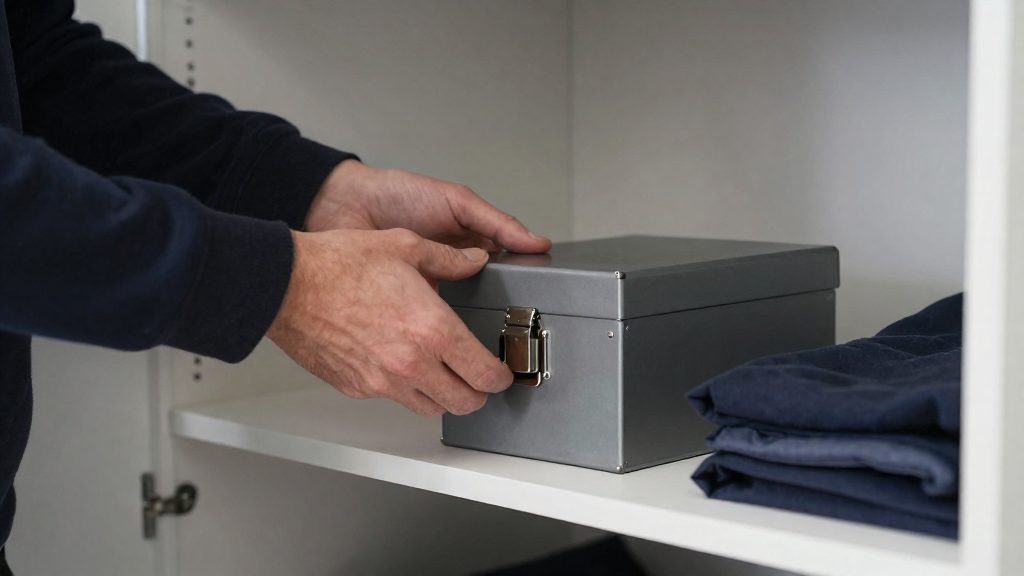
Why not keep your whole emergency fund at home?
Holding an entire emergency reserve as physical cash exposes it to losses that a bank account does not carry. Cash kept at home is not protected by the FDIC, so a theft or a fire can mean a loss that is not recoverable through deposit insurance. Three physical risks matter most:
- Theft: a single burglary can remove the whole stash at once.
- Fire: a fire can destroy banknotes completely, and the cash cannot be retrieved afterward.
- Flood and water damage: a burst pipe, a leak or a flooded basement can ruin cash stored at floor level.
Cash also earns no interest while it sits at home. Its nominal value stays the same, and its purchasing power falls if prices rise. A bank deposit account may pay interest on the same money.
Cash is also poorly suited to many payments. Large sums, online orders and most recurring bills cannot be settled with banknotes. These payments need a bank transfer, which requires money to be in an account. A reserve held only at home must therefore be withdrawn and deposited before it can cover them, adding a delay when money is needed quickly.
Only the cash portion of the reserve should be kept at home. The rest is better held in an account where it can be transferred, so that both the physical risks and the payment limits are reduced.
Does FDIC or insurance cover cash at home?
FDIC insurance covers deposit accounts at insured banks, not physical cash. Bank or credit union deposits are typically insured up to $250,000 per depositor, per institution by the FDIC or NCUA, which protects you if the institution fails. Cash kept at home falls outside that system: Utah State University Extension states that it is not protected by the FDIC. The limit applies only to deposits.
Other policies may cover part of the loss, but with limits. Renters insurance often covers cash theft, but the maximum claim is usually only a few hundred dollars. Homeowners policies may or may not cover cash lost to fire or burglary, so check your policy and confirm the coverage with your insurer or an insurance professional before relying on it.
| Where the money is held | Protection | Limit stated in source |
|---|---|---|
| Bank deposit | FDIC insurance | Up to $250,000 per account holder |
| Credit union deposit | NCUA insurance | Up to $250,000 per account holder |
| Cash kept at home | None from FDIC | Not covered by FDIC |
| Renters insurance (cash theft) | Often covered, depending on the policy | Maximum claim usually a few hundred dollars |
| Homeowners insurance (cash lost to fire or burglary) | Policy coverage, if included | Varies by policy |
Checking your own coverage
- Locate your renters or homeowners policy document, or the declarations page that summarizes it.
- Search the document for “cash,” “money,” or “currency” to find any sublimit.
- Note the dollar cap and whether it applies to theft, fire, or burglary.
- Compare that cap with the total cash you keep at home.
- Ask your insurer in writing to confirm the cap and how it applies to a single claim.
Any amount above the policy cap, or any loss the policy excludes, remains uninsured.
What size of cash stash fits your household?
Household size and dependants affect the total. Experian gives illustrative amounts for three household profiles. Use the method below to build your own number; the Experian examples show only how amounts can vary.
Method: per-person cost × people you support
- List what you would need to pay for if you had to evacuate: food, gas, and a motel stay.
- Price each item using local prices for your area, not national averages.
- Estimate the cost for one person.
- Multiply that per-person figure by the number of people you are responsible for, including dependants such as children or an adult relative in your care.
- Add the results to get the cash target for an evacuation.
The source applies the multiplication to the estimate as a whole. Motel rooms are often priced per room rather than per person, so that line may need a separate calculation.
Experian’s examples show how the target rises with household size and care needs:
| Household | Experian example | Context given in the source |
|---|---|---|
| One person living alone | About $200 | Major city |
| Couple | About $500 | Remote area |
| Family of five, one member needs medical support | $1,000 or more | Medical support need |
These figures are illustrations, not targets. Experian’s three examples differ in household size, location and medical needs, so they cannot be compared to isolate the effect of any single factor.
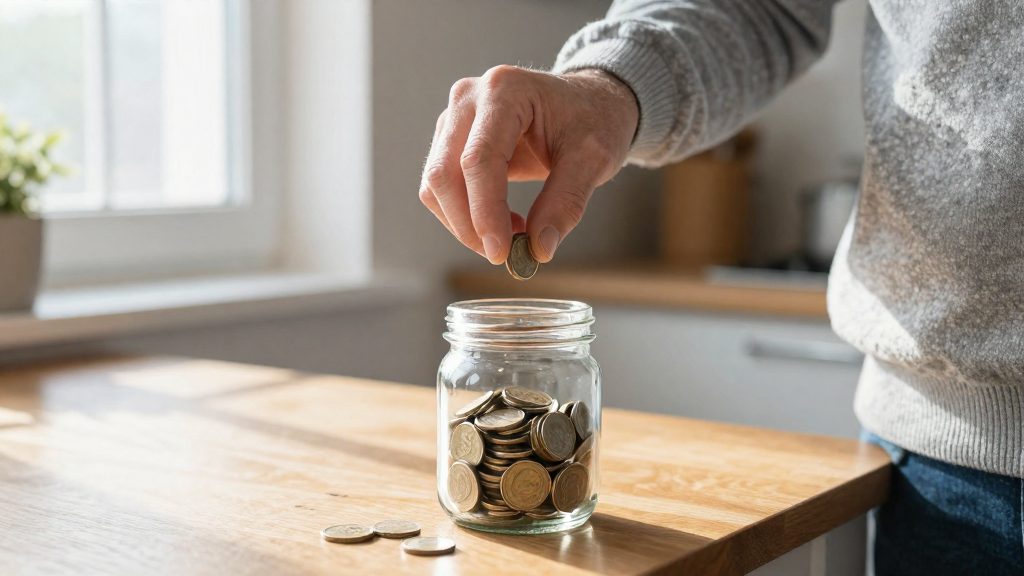
Which bills and coins are most useful?
For small purchases during a disruption, the denominations you hold matter as much as the total. Utah State University Extension recommends keeping low denominations: $1 and $5 bills, plus coins. Its reason is practical: sellers are more likely to make change for small bills.
$1 and $5 bills
These are the denominations the Extension names for small purchases.
Coins as a complement
Coins are listed alongside the small bills, not as a replacement for them. The Extension lists coins alongside the small bills.
Building a useful mix
- Start with $1 and $5 bills as the base of the supply.
- Add coins to cover amounts that the notes cannot match exactly.
- Avoid relying only on larger notes, since sellers are more likely to make change for small bills.
Where to store emergency cash safely
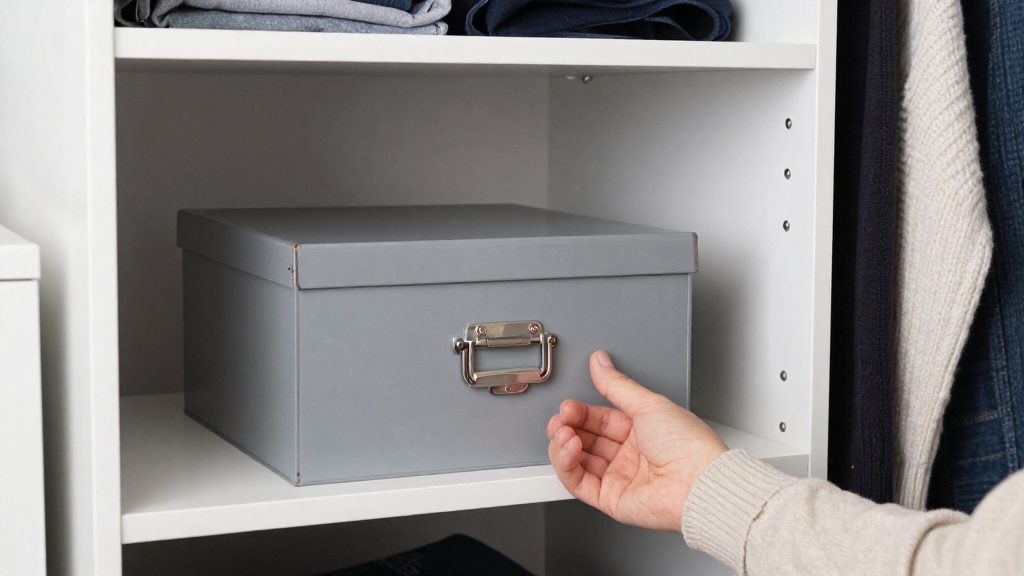
Home cash storage needs a container that addresses three risks: theft, fire, and water. Experian (2025-06-09) recommends a waterproof and fireproof home safe. Its prices, in US dollars, fall into three bands:
| Safe category | Typical price (Experian, 2025-06-09) |
|---|---|
| Small safe | about USD 40 |
| Larger safe | about USD 150 |
| Advanced model | USD 600 or more |
Prices vary by safe category, so choose according to the amount of cash you plan to hold.
Raising the safe off the floor is the step Experian advises when flooding is a risk, whereas Utah State University Extension recommends bolting a safe to the floor to deter theft. If both risks apply, weigh them and secure the safe to a solid structure above likely water levels.
For theft, Experian recommends securing the safe to a solid structure. Utah State University Extension goes further and recommends a small waterproof, fireproof safe bolted to the floor. Secure the safe to a solid structure, as Experian advises.
Placement is the other half of the protection. Utah State University Extension advises writing down where cash is hidden, keeping that list with your estate documents, and telling a few trusted people where it is. That record protects the cash if you cannot access it yourself.
How to build your cash reserve gradually
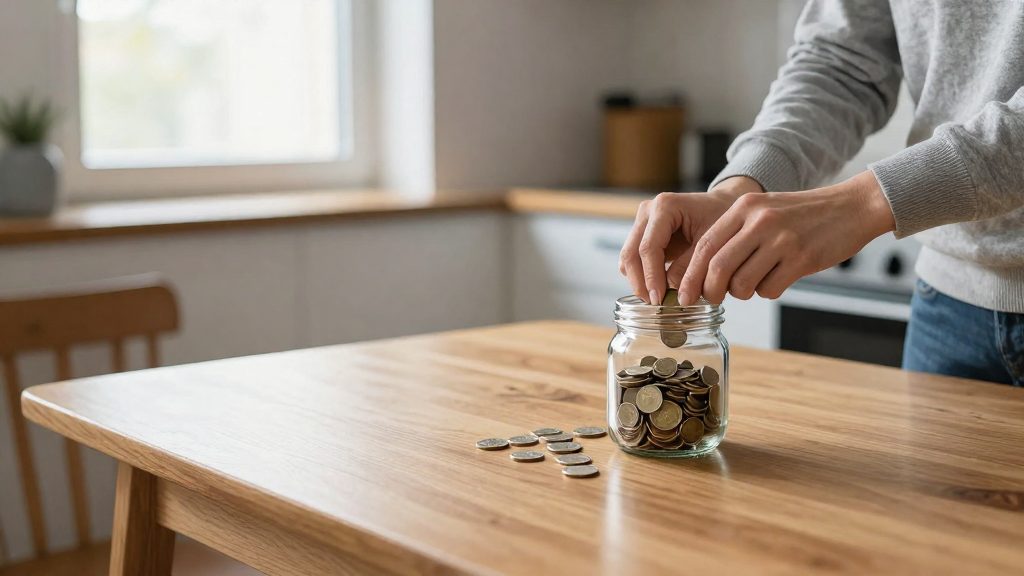
Building a phased accumulation plan means starting with a small sum and adding to it on a fixed schedule, rather than waiting until the full amount is available. Utah State University Extension uses $20 as its example starting point and recommends adding a set amount each month. The source does not specify that monthly figure, so choose one your budget can absorb without drawing on money set aside for bills.
- Start with an initial sum. Set aside $20 as the first entry. The aim at this stage is to establish the habit.
- Make a fixed monthly addition. Pick one amount and set it aside on the same day each month. Keep it separate from everyday spending money. Using the same amount each time makes the total grow at a predictable pace.
- Run periodic checks. Count the cash at regular intervals and compare the count with your written record. Record the date, the amount counted and any deposits or withdrawals since the last check. Neither source sets a checking routine; if you count your cash periodically, compare the count with your own written record.
- Set a milestone. Divide the path into intermediate targets and reach each one before setting the next. Experian’s examples can serve as reference points for a first milestone: about $200 for a person living alone in a major city, $500 for a couple in a remote area, and $1,000 or more for a family of five with a member who needs medical support. These are Experian’s illustrations (2025-06-09), not fixed requirements.
Frequently asked questions
How do I work out my own cash target?
Estimate the evacuation cost of food, gas and a motel, then multiply that total by the number of people you are responsible for. If that figure seems out of reach, start with a small sum such as USD 20 and add to it every month.
Is the cash I keep at home insured?
No. FDIC insurance covers bank and credit union deposits up to USD 250,000 per depositor at each institution, but it does not extend to cash stored in your house. Renters insurance often covers cash theft, usually only up to a few hundred dollars, while homeowners policies may or may not cover cash lost to fire or burglary, so check your own policy wording.
Which safe and which banknotes should I choose?
Experian recommends a waterproof and fireproof safe, with small models around USD 40, larger ones around USD 150, and advanced models at USD 600 or more. USU Extension suggests a small safe bolted to the floor and warns that decoy safes are often not fireproof. Keep low denominations such as USD 1 and USD 5 bills plus coins, since sellers are more likely to make change.